What is Restorative Yoga?
The Healing Art of Supported Stillness
In a world that prizes productivity and celebrates exhaustion as a badge of honor, the invitation to do nothing feels almost subversive. Yet this is precisely what restorative yoga offers: a practice built around the radical premise that rest itself is healing. In dimly lit studios and quiet corners of living rooms, practitioners arrange themselves on bolsters and blankets, settling into positions designed not to challenge the body but to cradle it. They hold these poses not for seconds or minutes but for ten, fifteen, even twenty minutes at a time, breathing slowly as muscles release and minds quiet. What emerges from this deliberate stillness is not merely relaxation but a profound physiological shift, a recalibration of the nervous system that modern science is only beginning to understand.
The Iyengar Foundation
The roots of restorative yoga lie in the work of B.K.S. Iyengar, the legendary Indian teacher who revolutionized yoga in the twentieth century. Born in 1918 in Bellur, Karnataka, Iyengar suffered from numerous childhood illnesses including malaria, tuberculosis, and typhoid fever. His frail constitution led his brother in law, the renowned yoga master T. Krishnamacharya, to begin teaching him yoga at age fifteen. This personal experience of healing through practice would shape Iyengar’s entire approach to the discipline.
Iyengar’s great innovation was the systematic use of props: blankets, blocks, bolsters, straps, chairs, and wall ropes that could support the body in positions that might otherwise be inaccessible or unsustainable. His 1966 book Light on Yoga became the foundational text of modern postural yoga, but equally important was his therapeutic application of these supported poses. When students arrived at his institute in Pune injured, ill, or recovering from surgery, Iyengar discovered that modified poses held for longer durations with proper support could facilitate remarkable healing. The props did not make yoga easier so much as they made it possible for anyone regardless of age, injury, or physical limitation.
This therapeutic approach formed the seedbed from which restorative yoga would eventually flower. Iyengar included restorative sequences in his classes, recognizing that recovery and regeneration were as essential to health as strength and flexibility. But it would take one of his American students to distill these principles into a distinct practice.
Judith Hanson Lasater and the Birth of Restorative Yoga
Judith Hanson Lasater discovered yoga in 1970 while a student at the University of Texas. Suffering from arthritis that left her feeling debilitated, she attended a class at the YMCA in Austin. She felt immediately better and has not suffered from arthritis since. Within a year, she was teaching; within a few more, she had become one of the earliest Western students of B.K.S. Iyengar, beginning studies with him in 1974 that would continue for twenty five years.
Lasater’s background uniquely positioned her to develop restorative yoga as a distinct practice. She earned a doctorate in East West psychology from the California Institute of Integral Studies and trained as a physical therapist at the University of California, San Francisco. This dual expertise in anatomy and psychology allowed her to understand both the physiological mechanisms and the psychological benefits of supported relaxation. She co founded Yoga Journal magazine in 1975 and the Iyengar Yoga Institute of San Francisco in 1978, becoming one of the most influential figures in American yoga.
In the late 1970s and 1980s, Lasater began evolving what she had learned from Iyengar into a practice specifically focused on relaxation and stress relief. Where Iyengar’s therapeutic applications addressed specific injuries and conditions, Lasater recognized that modern life itself had become a condition requiring treatment. Her 1995 book Relax and Renew: Restful Yoga for Stressful Times became the first volume devoted entirely to restorative techniques and remains the foundational text of the practice. She began offering dedicated workshops on restorative yoga in the 1990s and launched the first teacher certification program in 2001, establishing restorative yoga as a standalone discipline within the Western yoga landscape.
The Practice of Active Relaxation
Lasater defines restorative yoga as the use of props to support the body in positions of comfort and ease in order to facilitate health and relaxation. This definition contains a crucial distinction from other forms of yoga. In restorative practice, the goal is not to feel a stretch. Any sensation of stretching still involves muscular engagement, however subtle, and the entire point of restorative yoga is to eliminate muscular effort so that the body can enter a true physiological state of relaxation. The props do the work; the practitioner simply receives.
A typical restorative yoga class might include only four to six poses over sixty to ninety minutes. Each pose is held for extended periods, often ten to twenty minutes, giving the nervous system time to shift out of its habitual patterns. The room is kept warm and dimly lit. Soft music or guided meditation may accompany the practice. Teachers move quietly among students, adjusting props, offering blankets, ensuring that every part of every body is fully supported.
The props themselves are essential to the practice. Lasater’s original equipment list calls for a yoga mat, four yoga blocks, three firm bolsters, three hand towels, three eye bags, eight firm blankets, a six foot yoga strap, a folding metal chair, and two ten pound sandbags. For home practice, she suggests substituting throw pillows, couch cushions, or large bags of rice or dry beans. The point is not the specific equipment but the principle: the body must be so thoroughly supported that it can completely let go.
The Poses of Deep Rest
Restorative yoga draws from a relatively small repertoire of poses, each modified with extensive prop support. Supported Child’s Pose (Salamba Balasana) places the torso over a bolster with blankets cushioning the knees and ankles. The head rests to one side, arms drape along the bolster, and the entire back body is able to release. This pose calms the nervous system while gently opening the hips and lower back.
Supported Reclining Bound Angle Pose (Supta Baddha Konasana) has become perhaps the signature restorative position. The practitioner lies back over a bolster placed lengthwise along the spine, with the soles of the feet together and knees falling outward, supported by blocks or rolled blankets. This gentle heart opener stretches the inner thighs while creating a profound sense of surrender in the chest and belly. Many teachers consider it the single most beneficial pose for counteracting the forward hunching posture of modern life.
Legs Up the Wall (Viparita Karani) is a simple inversion that requires minimal equipment: just a wall and perhaps a folded blanket under the hips. The legs rest against the wall while the torso lies flat, allowing blood to flow back toward the heart and head. This pose relieves fatigue in the legs, calms the nervous system, and is often recommended for insomnia. Supported Bridge Pose (Salamba Setu Bandhasana) places a block or bolster under the sacrum, allowing the pelvis to release while gently opening the front body.
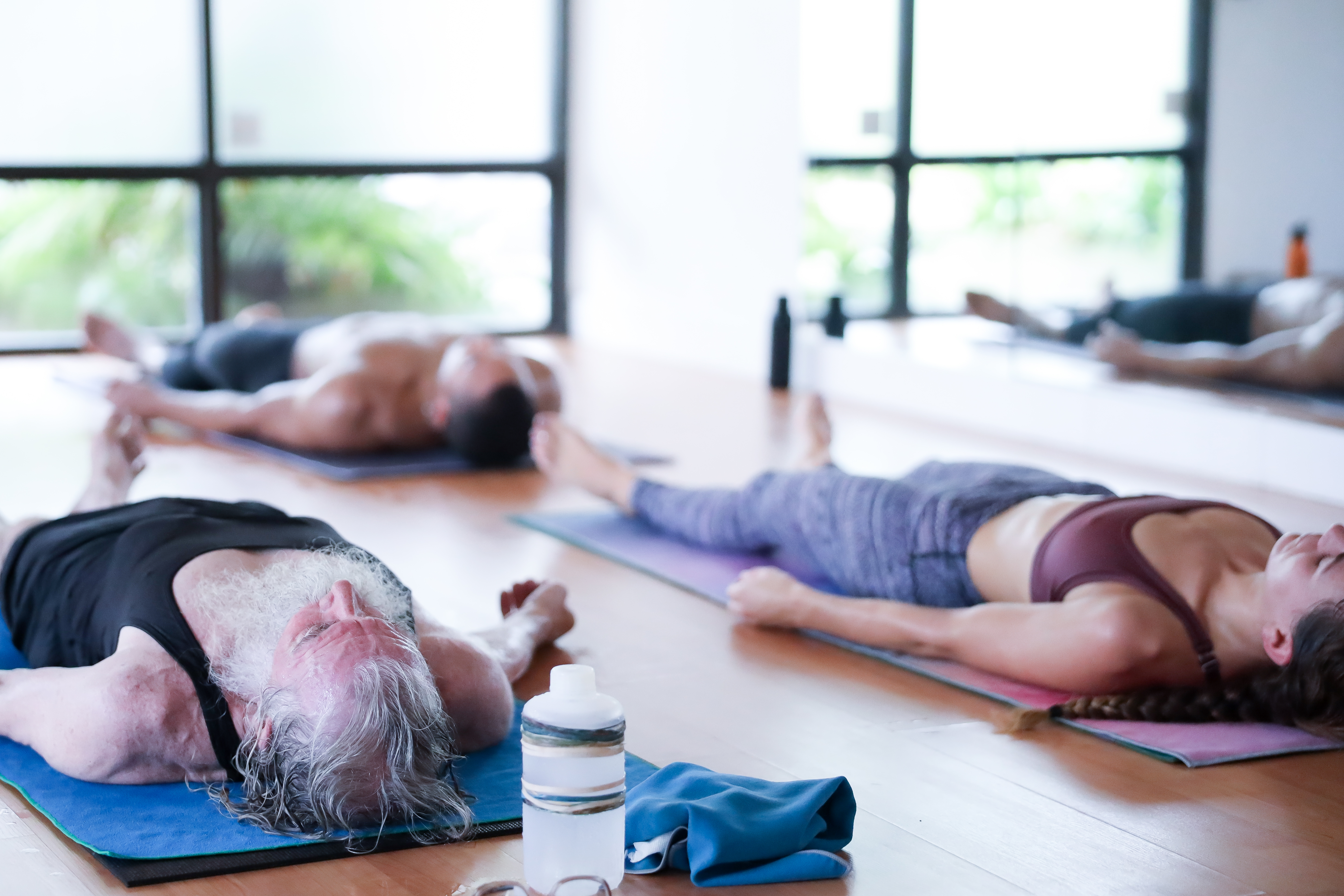
Supported Savasana, the ultimate relaxation pose, places a bolster under the knees to relieve pressure on the lower back, a folded blanket under the head to create a gentle chin tuck, and often an eye pillow and blanket over the body. Some teachers add sandbags on the thighs for grounding weight. This seemingly simple position, when properly supported, allows for the deepest possible relaxation of body and mind.
The Science of Relaxation
The physiological basis of restorative yoga lies in the autonomic nervous system, particularly the balance between its two branches. The sympathetic nervous system governs the body’s response to stress, triggering the release of adrenaline and cortisol, raising heart rate and blood pressure, diverting blood from digestion and reproduction toward the large muscles needed for fight or flight. This system evolved to protect us from immediate physical threats, but in modern life it often remains chronically activated by psychological stressors that never resolve: work pressure, financial anxiety, relationship difficulties, the constant stimulation of digital devices.
The parasympathetic nervous system governs the opposite functions: rest, digestion, tissue repair, immune function. When activated, heart rate slows, blood pressure drops, blood flow returns to the digestive organs, muscles relax, and the body enters a state conducive to healing and regeneration. This is sometimes called the relaxation response, a term coined by Harvard physician Herbert Benson in the 1970s to describe the measurable physiological changes that occur during meditation and deep relaxation.
Restorative yoga is specifically designed to activate the parasympathetic nervous system. The supported positions eliminate the muscular tension that signals threat to the brain. The darkened room removes visual stimulation. The extended holds give the nervous system time to recognize that it is safe and can stand down from high alert. Research on the vagus nerve, which serves as the primary pathway of the parasympathetic system, has shown that practices like deep breathing and supported relaxation can improve vagal tone, essentially strengthening the body’s capacity to return to calm after stress.
Research and Therapeutic Applications
Scientific research on restorative yoga specifically is still emerging, but studies on yoga and relaxation practices more broadly support the claimed benefits. A study published in the Journal of Alternative and Complementary Medicine found that participants who practiced restorative yoga experienced significant reductions in cortisol levels, the primary stress hormone. Research in the International Journal of Yoga found that individuals practicing restorative yoga reported better sleep quality and fewer disturbances throughout the night.
Chronic pain represents one of the most promising applications of restorative yoga. A 2020 review of twenty five randomized controlled trials examining yoga for back pain found that twenty studies reported positive outcomes in variables such as pain, psychological distress, and energy levels. Research published in Pain Medicine found that restorative yoga significantly reduced pain intensity and improved functional capacity in patients with chronic low back pain. The gentle nature of the practice makes it accessible to those who cannot tolerate more vigorous exercise.
Mental health benefits are equally well documented. The consistent practice of yoga has been shown to increase serotonin levels while decreasing cortisol and monoamine oxidase, an enzyme that breaks down neurotransmitters. Studies have linked yoga practice to reduced symptoms of anxiety and depression. For those dealing with trauma, the supported stillness of restorative yoga can provide a safe container for processing difficult emotions without the intensity of more active practices.
Additional benefits documented in research include improved immune function, reduced blood pressure, enhanced flexibility and range of motion, and better quality of life for those with chronic conditions including cancer, arthritis, and fibromyalgia. A study of female fibromyalgia patients found that a tailored yoga program produced significant improvements in pain, fatigue, mood, acceptance, and coping strategies.
Restorative Yoga and Yin Yoga: A Crucial Distinction
Restorative yoga is frequently confused with Yin yoga, another slow paced practice that uses props and long holds. The two styles share surface similarities but differ fundamentally in intention and execution. Understanding this distinction is essential for practitioners seeking the specific benefits each practice offers.
Yin yoga, developed by Paul Grilley and Sarah Powers based on the teachings of martial artist Paulie Zink, targets the deep connective tissues of the body: fascia, ligaments, tendons, and joints. Practitioners find an edge of sensation in each pose and hold it for three to five minutes, allowing the slow, sustained stress to gradually reshape these Yin tissues. The experience is often uncomfortable, requiring mental fortitude to remain still while experiencing significant stretching sensations. The goal is increased flexibility, improved joint mobility, and the release of blocked energy along meridian lines.
Restorative yoga, by contrast, seeks to eliminate all sensation of stretch. As Bernie Clark, a prominent Yin yoga teacher, explains: Restorative yoga takes an unhealthy body and brings it back to normal, while Yin yoga takes a normal healthy body and brings it up to optimum. In restorative practice, any discomfort is a signal to add more support, not to breathe through it. The body should be so completely held that muscles have nothing to do. People often fall asleep in restorative yoga; they rarely do in a true Yin class.
The prop usage differs accordingly. In Yin yoga, props help practitioners find an appropriate edge without overstretching; in restorative yoga, props eliminate the edge entirely, raising the floor to meet the body so that gravity creates no demand. Pose duration also differs: while both practices use longer holds than dynamic yoga, restorative poses are typically held longer, from five to twenty minutes versus three to five in Yin. A restorative class might include only three or four poses; a Yin class typically includes more.
Who Benefits from Restorative Yoga
One of restorative yoga’s great strengths is its accessibility. Unlike practices that require strength, flexibility, or cardiovascular conditioning, restorative yoga asks nothing of the body except the willingness to be still. This makes it appropriate for beginners with no yoga experience, elderly practitioners with limited mobility, those recovering from illness or injury, pregnant women seeking gentle practice, and athletes needing recovery between intense training sessions.
Yet restorative yoga is not only for those who cannot do more vigorous practice. High performers in demanding careers often find that the forced slowdown provides exactly what their overstimulated nervous systems need. Those who gravitate toward intense exercise may benefit most from the counterbalance of deep rest. The practice can complement active yoga styles, providing recovery that allows the body to integrate the benefits of more challenging work.
Those dealing with chronic stress, anxiety, insomnia, or burnout represent perhaps the largest population for whom restorative yoga is specifically indicated. In a 2018 survey by the Mental Health Foundation in the UK, 74 percent of respondents reported feeling so stressed they were overwhelmed or unable to cope. For these practitioners, restorative yoga offers not an escape from stress but a systematic methodology for teaching the nervous system how to return to baseline.
Beginning a Restorative Practice
For those new to restorative yoga, beginning with a class taught by an experienced teacher is strongly recommended. Proper propping requires attention to details that are difficult to learn from books or videos: the exact angle of a bolster, the placement of blankets to support the neck, the height needed under the knees. A skilled teacher can observe where tension remains in the body and adjust accordingly.
Classes are widely available at yoga studios, gyms, and community centers. Many are offered in the evening, recognizing that the practice prepares the body for sleep. Some studios offer dedicated restorative classes while others incorporate restorative poses into gentle or therapeutic yoga sessions. Online classes and videos have made the practice accessible to those without local options, though the guidance of a live teacher remains valuable.
For home practice, experts recommend starting with one or two sessions per week lasting twenty to sixty minutes. Even a single supported pose held for ten minutes can provide meaningful benefits. Building a prop collection gradually makes home practice more effective: start with blankets and pillows from around the house, then add a bolster, blocks, and straps as commitment to the practice deepens. Many practitioners find that Legs Up the Wall, requiring only a wall and perhaps a blanket, becomes a daily touchstone of calm.
The Counter Cultural Practice of Rest
In her writing and teaching, Judith Hanson Lasater often notes that taking time for relaxation is counter cultural in our society. We value doing over being, productivity over presence, achievement over acceptance. The very idea that lying still on blankets constitutes a legitimate practice worthy of time and attention can feel uncomfortable to those conditioned to measure worth by output.
Yet our biology requires rest for health. The physiological processes of tissue repair, immune function, memory consolidation, and emotional regulation all depend on the parasympathetic state that chronic stress prevents us from accessing. When we fail to rest adequately, we borrow against our own reserves, accumulating what stress researchers call allostatic load: the cumulative wear on body and mind from sustained activation of stress response systems.
Restorative yoga offers a structured, intentional, and supported way to access the rest our bodies need. It is not passive in the sense of being without effort; it requires the effort of showing up, of setting aside time, of resisting the pull toward productivity. Lasater calls it active relaxation: a conscious practice of surrender that, paradoxically, requires commitment and discipline to maintain.
The Gift of Stillness
The practice of restorative yoga represents an invitation to trust that rest itself is valuable, that the body knows how to heal when given the conditions to do so, that stillness is not emptiness but fullness of a different kind. In a culture that often treats exhaustion as achievement and busy as a moral virtue, this invitation can feel radical. Yet the science supports what practitioners have long known through experience: that deliberate, supported rest changes the body at the level of the nervous system, creating resilience that carries into daily life.
For those who have never tried restorative yoga, the practice may seem too simple to be effective. How can lying on blankets for an hour produce meaningful change? The answer lies in understanding that meaningful change in the nervous system requires time, repetition, and safety. The elaborate prop setups of restorative yoga create physical conditions in which the body can recognize that no threat exists, no effort is required, no achievement is expected. From this recognition, the parasympathetic response emerges naturally.
Perhaps the deepest teaching of restorative yoga is that we do not need to earn rest through exhaustion or justify relaxation through productivity. Rest is not a reward for work but a biological necessity for life. The bolsters and blankets, the darkened room and the quiet music, the long holds and the slow breath: all of these serve to remind us of something we have forgotten in our constant striving. We are allowed to stop. We are allowed to be held. We are allowed to let go.
References
[1] Wikipedia. “Restorative Yoga.” https://en.wikipedia.org/wiki/Restorative_Yoga
[2] Wikipedia. “Judith Hanson Lasater.” https://en.wikipedia.org/wiki/Judith_Hanson_Lasater
[3] Oprah Daily. “Restorative Yoga Health Benefits.” https://www.oprah.com/health_wellness/restorative-yoga-health-benefits
[4] Yogapedia. “What is Restorative Yoga?” https://www.yogapedia.com/definition/5488/restorative-yoga
[5] YogaUOnline. “Relaxation Response and How Restorative Yoga Contributes.” https://yogauonline.com/yoga-health-benefits/yoga-for-stress-relief/learn-all-about-the-relaxation-response-and-how-restorative-yoga-can-initiate-it/
[6] Cleveland Clinic. “How Restorative Yoga Can Nurture Your Mind, Body and Soul.” https://health.clevelandclinic.org/restorative-yoga
[7] Balance. “Restorative Yoga & the Parasympathetic Nervous System.” https://balance.co.uk/restorative-yoga-the-parasympathetic-nervous-system/
[8] RePose Lifestyle. “Restorative Yoga: The Art & Science of Relaxation.” https://reposelifestyle.com/2017/12/art-and-science-of-relaxation/
[9] PMC/NIH. “Exploring the therapeutic effects of yoga and its ability to increase quality of life.” https://pmc.ncbi.nlm.nih.gov/articles/PMC3193654/
[10] NCCIH. “Yoga for Pain: What the Science Says.” https://www.nccih.nih.gov/health/providers/digest/yoga-for-pain-science
[11] Yoga Journal. “What’s the Difference Between Yin Yoga and Restorative Yoga?” https://www.yogajournal.com/practice/whats-the-difference-between-yin-yoga-and-restorative-yoga/
[12] YinYoga.com. “Yin Yoga or Restorative Yoga?” https://yinyoga.com/yin-yoga-or-restorative-yoga/
[13] Seeking OM. “Restorative Yoga: History, Science & Real Benefits.” https://seekingom.yoga/blogs/blog/restorative-yoga
[14] Yoga Journal. “The Scientific Basis of Yoga Therapy.” https://www.yogajournal.com/teach/the-scientific-basis-of-yoga-therapy/


