
The Controversial Practice of Awakening the Serpent Power
Walk into a Kundalini yoga class and you enter a world unlike any other corner of the Western yoga studio landscape. Practitioners dressed in flowing white garments sit cross legged on sheepskin rugs, heads wrapped in turbans. The teacher chants in an ancient Punjabi script called Gurmukhi. Students pump their arms rapidly while breathing in short, forceful bursts. Eyes closed, they repeat mantras for minutes on end, sometimes swaying, sometimes crying, occasionally reporting visions or waves of energy moving through their bodies. This is the yoga of awareness, a practice that promises to awaken dormant spiritual energy coiled at the base of the spine and send it rising through the chakras toward enlightenment. It is also a practice shadowed by profound controversy: questions about its origins, its founder’s fabricated claims, and allegations of systematic abuse that have shattered communities and forced practitioners to grapple with whether the teachings can be separated from the teacher.
The Serpent Energy
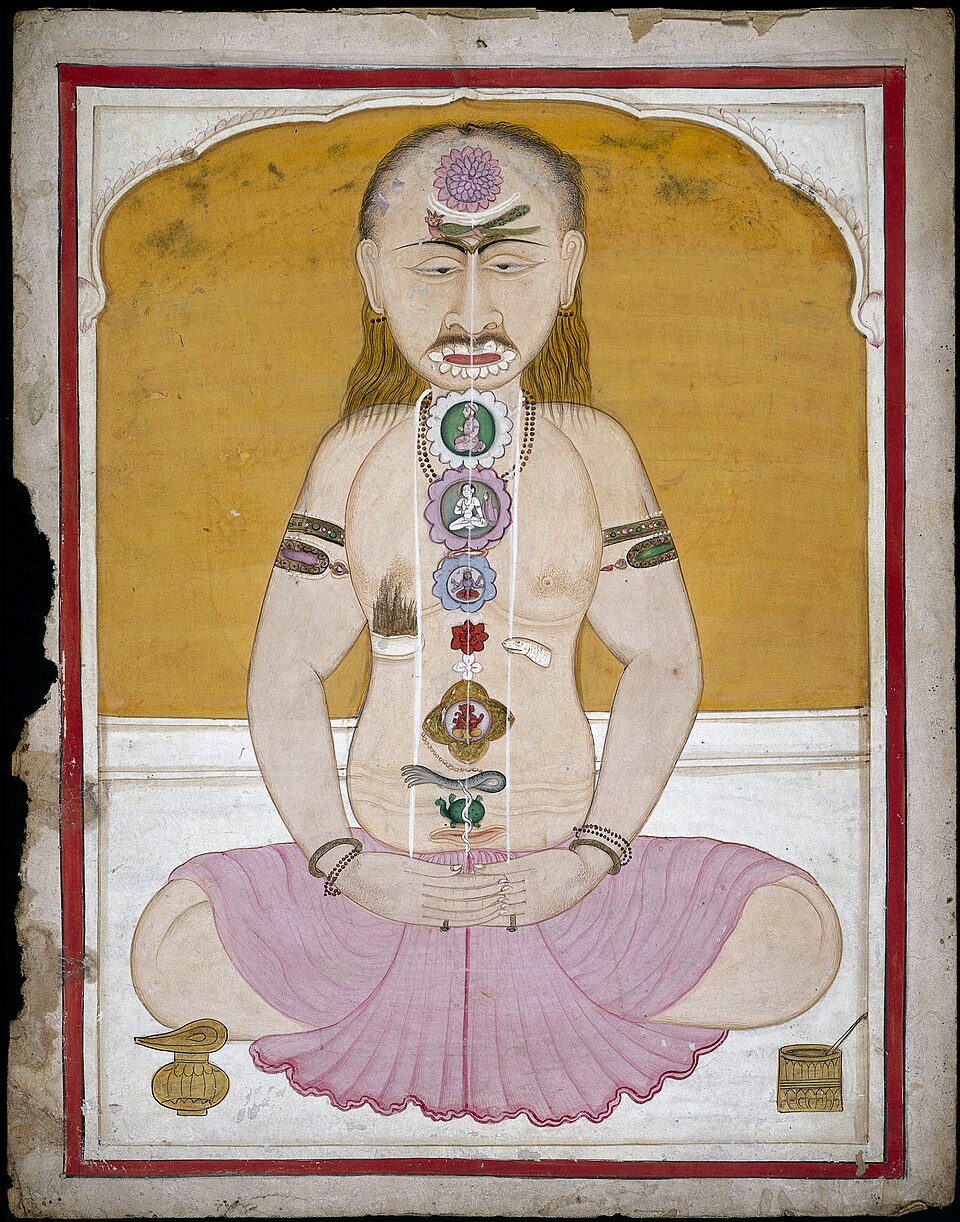
The word kundalini comes from the Sanskrit term meaning coiled, typically depicted as a serpent lying dormant at the base of the spine near the root chakra. In Hindu and Tantric traditions, this energy represents the divine feminine principle, Shakti, waiting to be awakened and united with Shiva, the masculine consciousness residing at the crown of the head. When aroused through specific practices, kundalini is said to travel upward through a central energy channel called the sushumna, piercing each of the seven chakras in succession until it reaches the sahasrara at the top of the skull. This culminating union produces states of expanded consciousness, bliss, and spiritual liberation.
References to kundalini appear in ancient yoga texts including the Yoga Kundalini Upanishad and the Hatha Yoga Pradipika, which describes how mixing prana and apana energies generates heat that raises the serpent power. Traditional methods for awakening kundalini included years of intensive practice under close supervision of a guru, involving asana, pranayama, mantra, meditation, and strict ethical observances. The process was considered potentially dangerous: texts warned that improper awakening could cause physical illness, psychological disturbance, or spiritual crisis. For this reason, the teachings were traditionally kept secret, passed only from master to disciple after extensive preparation.
Yogi Bhajan and the Western Introduction
The Kundalini yoga practiced in studios across the Western world today is almost entirely the creation of one man: Harbhajan Singh Puri, known to his followers as Yogi Bhajan or by the title Siri Singh Sahib. Born on August 26, 1929 in Kot Harkarn in the Punjab region of what is now Pakistan, he was raised in a Sikh family and educated at a Catholic school run by nuns. His official biography claimed that he was declared a master of Kundalini yoga at age sixteen by a teacher named Sant Hazara Singh, though this claim has been disputed by historians who have investigated his background.
The 1947 partition of India forced his family to flee to New Delhi as refugees, where Harbhajan Singh completed a degree in economics and entered government service, eventually becoming a customs inspector at Delhi Airport. In 1968, armed with an endorsement letter from James George, the Canadian High Commissioner to India who had been his student, he emigrated to Toronto. After a brief stay in Canada, he arrived in Los Angeles in late 1968 and began teaching yoga.
His timing proved fortuitous. The counterculture movement had created a generation of young Americans hungry for Eastern spirituality, altered states of consciousness, and alternatives to mainstream religion. Yogi Bhajan found his audience among the hippies of Los Angeles, whom he called searching souls. He offered them vigorous physical practices, meditation techniques, a vegetarian lifestyle, and an embracing holistic vision with what one observer described as an optimistic spirit of sublime destiny. In 1969, he established the 3HO Foundation, an acronym for Healthy, Happy, Holy Organization, to formalize his teachings.
Questions of Authenticity
For decades, Yogi Bhajan promoted his teachings as an ancient and secret tradition that he was the first to openly reveal to the public. The official 3HO narrative claimed the practice had been passed down for thousands of years through a lineage connected to the Sikh Gurus, particularly Guru Ram Das, the fourth Sikh Guru who founded the holy city of Amritsar. Bhajan asserted that the historical Sikh Gurus practiced the same Kundalini yoga he taught.
This narrative has been substantially challenged by academic research. In 2012, Philip Deslippe, a historian of American religion, published a detailed article titled From Maharaj to Mahan Tantric: The Construction of Yogi Bhajan’s Kundalini Yoga. Drawing on archival 3HO materials, contemporary newspaper accounts, and interviews with early students and associates, Deslippe concluded that Kundalini yoga as taught by Yogi Bhajan was not an ancient secret tradition but rather a bricolage, a construction assembled from multiple sources.
According to Deslippe’s research, the physical asanas and breathing exercises derived primarily from Yogi Bhajan’s studies with Swami Dhirendra Brahmachari, a prominent Indian hatha yoga teacher. The chanting and devotional practices had their origins in the teachings of Maharaj Virsa Singh, a Sikh sant at whose ashram, Gobind Sadan, Bhajan had studied in his final years in India. Deslippe found that the figure of Sant Hazara Singh, whom Bhajan claimed as his primary teacher, only became prominent in the official narrative after Bhajan had a falling out with Virsa Singh following a trip to India in 1970 and 1971.
Traditional Sikh authorities in India also raised concerns. A letter from the Akal Takht, the highest temporal seat of Sikh religious authority, expressed shock at Bhajan’s fantastic theories. Sikh High Priest Jaswant Singh declared that yoga, tantrism, and the sexual practices taught by Bhajan were forbidden and immoral according to Sikh doctrine. Scholar Christopher Wallis, writing on the original Sanskrit sources of kundalini yoga, has stated that the modern practice created by Yogi Bhajan is entirely an invention of the 20th century with no relation to what is taught as kundalini yoga in the original Sanskrit sources.
The Structure of Practice
Despite questions about its origins, the practice that Yogi Bhajan systematized has become one of the most formalized styles of yoga taught worldwide. Classes follow a precise structure that teachers are trained not to alter, as each element is considered essential to achieving specific effects on body, mind, and consciousness.
Every class begins with the Adi Mantra: Ong Namo Guru Dev Namo, chanted three times. This translates roughly as I bow to the creative consciousness, I bow to the divine teacher within. The chanting is said to tune the practitioner into what is called the Golden Chain, a connection to the lineage of masters whose wisdom flows through the practice. A second protective mantra, Aad Guray Nameh, may follow. These opening chants serve both to center the mind and to establish the spiritual context that distinguishes Kundalini yoga from purely physical exercise.
The core of each class is a kriya, a precisely structured sequence of exercises designed to produce specific outcomes. Unlike the flowing sequences of vinyasa yoga, kriyas often involve repetitive movements held for specific durations, combined with particular breathing patterns and sometimes mantras or mudras. A kriya might target the nervous system, balance the chakras, increase vitality, or address specific conditions like anxiety or addiction. Teachers are trained to present kriyas exactly as taught, without modification, as the specific combination and sequence of elements is considered essential to their effectiveness.
Breath of Fire, perhaps the signature breathing technique of Kundalini yoga, involves rapid, rhythmic breathing through the nose with equal emphasis on inhale and exhale, powered by pumping the navel point. Practiced correctly, it generates internal heat, stimulates the solar plexus chakra, oxygenates the blood, and energizes the nervous system. Other breathing techniques include long deep breathing for calming, alternate nostril breathing for balance, and various suspensions of the breath combined with internal locks called bandhas.
White Clothing and Turbans
Walk into most Kundalini yoga classes and you will notice that instructors, and often dedicated students, dress in white from head to toe. Many also wear turbans or other head coverings. These visible markers distinguish Kundalini yoga from other yoga styles and reflect teachings that Yogi Bhajan emphasized throughout his career.
According to Bhajan’s teachings, white clothing expands the practitioner’s electromagnetic field, or aura, extending it by an additional foot beyond the normal nine foot radius he claimed surrounded every body. White is also said to be cleansing and protective, creating a shield against negative energy and illness. The head covering serves multiple purposes: containing the energy generated during practice, protecting the crown chakra, creating slight cranial pressure that stabilizes the small bones of the skull and affects the nervous system, and focusing energy at the third eye center where the pineal gland resides.
Neither white clothing nor head covering is required to attend a Kundalini yoga class. Newcomers are welcome in any comfortable clothing. But the prevalence of these elements creates a distinctive visual atmosphere that marks Kundalini as something different from the yoga pants and tank tops of a typical studio class. For practitioners who adopt the full traditional dress, it becomes a daily reminder of their commitment to the practice and its spiritual dimensions.
The Power of Sacred Sound
Mantra forms the sonic backbone of Kundalini yoga. Unlike styles where chanting might be optional or minimal, Kundalini classes incorporate mantras throughout the practice, drawing on Gurmukhi, the sacred script of the Sikh tradition. These sounds are considered not merely devotional expressions but precise technologies of consciousness, each producing specific vibrational effects on the body and mind.
The most fundamental mantra is Sat Nam, meaning truth is my identity or truth is my name. It serves as both greeting among practitioners and closing mantra at the end of class. The syllables are coordinated with breath: a long Sat on the inhale, a short Nam on the exhale. This simple practice is said to awaken the soul and align the individual identity with universal truth.
Other commonly used mantras include Wahe Guru, an expression of ecstatic wonder at the divine; Har, a name of the creative infinity; and the extended Mul Mantra from the Sikh tradition that describes the nature of the one creator. The meditation called Kirtan Kriya uses the sequence Sa Ta Na Ma, representing the cycle of infinity, life, death, and rebirth, while touching the thumb to each finger in sequence. This particular meditation has been the subject of scientific research showing effects on brain function and memory.
Scientific Research
Among yoga styles, Kundalini has been relatively well studied by researchers interested in its effects on mental health conditions. The combination of physical movement, controlled breathing, meditation, and mantra provides a multifaceted intervention that researchers hypothesize may be more effective than purely physical yoga practices.
A 2020 randomized controlled trial published in JAMA Psychiatry compared Kundalini yoga to cognitive behavioral therapy, the gold standard psychological treatment, for generalized anxiety disorder. The study of 226 adults found that Kundalini yoga was significantly more effective than stress education alone and showed promise as an intervention for anxiety, though CBT demonstrated somewhat better long term outcomes. The National Center for Complementary and Integrative Health, which funded the study, concluded that Kundalini yoga may be a helpful but moderately potent intervention for anxiety disorders, potentially valuable given barriers to accessing trained mental health professionals.
Research on the Kirtan Kriya meditation has shown particularly promising results. Studies conducted at UCLA, the University of Pennsylvania, and the Alzheimer’s Research and Prevention Foundation found that practicing this twelve minute meditation daily for eleven weeks produced measurable improvements in memory, reduced stress and anxiety, enhanced blood flow to the brain, and favorable changes in gene expression related to immune function and disease processes. A systematic review of randomized controlled trials found that Kundalini yoga significantly reduced symptoms of anxiety, depression, OCD, and PTSD compared to control groups.
Additional research has documented reductions in perceived stress and serum cortisol levels among medical students practicing Simplified Kundalini Yoga over twenty four weeks. Studies on university students during the COVID 19 pandemic found improvements in mental health outcomes from online Kundalini yoga interventions. The practice has also been studied for its effects on emotion regulation, resilience, and fatigue in various populations.
The Abuse Scandal
In December 2019, Pamela Saharah Dyson, who had served as Yogi Bhajan’s personal secretary and held the spiritual name Premka Kaur Khalsa, published a memoir titled Premka: White Bird in a Golden Cage. The book detailed her sixteen years in Bhajan’s inner circle, including allegations that he forced her into a sexual relationship, ordered her to abort a pregnancy, and controlled her access to other relationships. The book’s publication opened a floodgate of similar allegations from other former followers.
In response to the mounting allegations, the Siri Singh Sahib Corporation, which oversees the cluster of organizations Bhajan founded, commissioned an independent investigation by An Olive Branch, a consultancy specializing in addressing misconduct in spiritual communities. The investigation, which concluded in August 2020, interviewed or received statements from 299 individuals: 96 identified as victims or reporters of harm, 140 supported Bhajan or refuted allegations, and 63 made comments outside the investigation’s scope.
The findings were devastating. The report concluded that much of the alleged conduct more likely than not occurred. Under sexual abuse, investigators documented four claims of rape, eight of physical injury during sex, nine of unwanted touching in intimate areas, and three of unwanted exposure to pornography. An additional thirty claims of sexual harassment and thirty of unethical behavior were recorded. The report also documented allegations that Bhajan managed followers by controlling access to information, directing major life decisions including whom to marry and when to have children, and creating a culture that discouraged criticism. Many victims reported viewing Bhajan as endowed with divine attributes that placed him on a higher plane, language that investigators noted facilitated his misconduct.
The report divided the community. Some teachers and organizations distanced themselves from the 3HO structure, with some stopping teaching Kundalini yoga entirely while others chose to continue the practices independent of the organizational apparatus. Videos circulated of former members burning their Kundalini yoga manuals. Others continued to revere Bhajan as their spiritual teacher, commissioning a separate review that attempted to discredit the An Olive Branch findings on technical grounds. The question posed at the end of the report remains the central one facing the community: Going forward, can the community rally around Bhajan’s own advice to follow the teachings, not the teacher?
Kundalini Yoga Today
The abuse scandal and historical revelations have forced the Kundalini yoga community into an ongoing reckoning that shows no signs of resolution. Some practitioners have abandoned the practice entirely, unable to separate the techniques from their tainted origin. Others argue that the practices themselves, regardless of their actual provenance, produce real benefits that justify continued use. Still others continue to venerate Yogi Bhajan while dismissing or minimizing the allegations against him.
For newcomers approaching Kundalini yoga today, awareness of this context is essential. Classes continue to be offered at yoga studios worldwide, taught by instructors certified through the Kundalini Research Institute. The practice maintains devoted followers who report profound benefits for mental health, stress reduction, and spiritual development. The research base, while not extensive, suggests genuine therapeutic potential particularly for anxiety and related conditions.
Yet the practice cannot be fully understood without acknowledging the controversies that surround it. The lineage claims were fabricated. The founder was found more likely than not to have committed serious sexual abuse. The organizational structure he created exhibited characteristics researchers have identified as cult like. These facts do not necessarily invalidate the practices themselves, many of which derive from legitimate if different sources than claimed. But they do demand a level of critical engagement that the tradition itself historically discouraged.
What to Expect in Class
A typical Kundalini yoga class lasts sixty to ninety minutes and follows a consistent structure regardless of location. After the opening mantras, the teacher guides students through pranayama exercises to prepare the body and mind. The main practice is a kriya selected for its particular effects, which might target the nervous system, the glandular system, a specific chakra, or a life challenge like releasing fear or building courage. Following the kriya comes a period of deep relaxation, allowing the body to integrate the effects of the practice.
Meditation, often lasting anywhere from three to thirty one minutes, follows relaxation. These meditations typically incorporate mantra, mudra, eye focus, and breath in specific combinations. The class closes with the song Long Time Sun, a blessing for wellbeing, and three repetitions of Sat Nam. Throughout the practice, teachers may offer modifications for those with physical limitations, and students are encouraged to rest when needed rather than pushing past their capacity.
The intensity of Kundalini yoga varies significantly depending on the kriya practiced. Some classes are gentle and meditative, accessible to beginners and those with physical limitations. Others involve challenging exercises held for extended periods, rapid breathing that can cause dizziness until the body adapts, and emotional releases that may catch newcomers off guard. The combination of physical exertion, hyperventilation, repetitive movement, and group chanting can produce altered states of consciousness that some find transformative and others find overwhelming.
Cautions and Considerations
Traditional texts warned that awakening kundalini energy without proper preparation could cause physical and psychological problems. While the dramatic kundalini crises described in classical literature are rare, the intensity of the practice does warrant caution. Those with high blood pressure, heart conditions, or pregnancy should consult healthcare providers before practicing. Women are advised to avoid Breath of Fire and strenuous exercise during the first three days of menstruation. Those with a history of mental health conditions, particularly psychosis or dissociative disorders, should approach the practice carefully if at all.
Beyond medical considerations, the spiritual intensity of Kundalini yoga and its historical context of authoritarian leadership create specific risks. Practitioners should maintain their critical faculties, question teachings that do not resonate, and avoid teachers or communities that demand unquestioning obedience or create dependency. The practice can be a powerful tool for self development, but only when approached with appropriate discernment and boundaries.
The Yoga of Awareness
Kundalini yoga as practiced in the West today is neither what its founder claimed it to be nor a worthless fabrication. It is a syncretic creation of the twentieth century, drawing from multiple legitimate sources in Indian yoga and Sikh devotional practice, assembled and marketed by a charismatic teacher whose personal conduct contradicted the ethical standards he publicly espoused. The techniques themselves appear to have real effects on the nervous system, the endocrine system, and psychological wellbeing, effects that have begun to be validated by scientific research even as the founder’s legacy has been discredited.
For those drawn to its practices, Kundalini yoga offers tools of considerable power: breathing techniques that can shift the state of the nervous system in minutes, meditations that research suggests improve brain function and mental health, physical exercises that challenge and strengthen the body, and mantras whose vibrational effects practitioners experience as tangible. These tools need not depend on belief in fabricated lineages or veneration of a disgraced teacher. They can be engaged pragmatically, tested against personal experience, retained if useful and discarded if not.
The serpent power may or may not rise through the chakras toward enlightenment. But the practice called Kundalini yoga, approached with awareness and appropriate skepticism, can serve as a genuine path toward self knowledge, stress reduction, and enhanced wellbeing. Its complicated history serves as a reminder that the source of a teaching does not determine its value, that spiritual practices can be beneficial even when their containers are corrupted, and that the ultimate teacher, as the opening mantra suggests, resides not in any external authority but within.
References
[1] Wikipedia. “Kundalini yoga.” https://en.wikipedia.org/wiki/Kundalini_yoga
[2] Wikipedia. “Yogi Bhajan.” https://en.wikipedia.org/wiki/Yogi_Bhajan
[3] Wikipedia. “3HO.” https://en.wikipedia.org/wiki/3HO
[4] Taylor & Francis. “From Maharaj to Mahan Tantric: The Construction of Yogi Bhajan’s Kundalini Yoga” by Philip Deslippe. https://www.tandfonline.com/doi/abs/10.1080/17448727.2012.745303
[5] Yoga Basics. “Kundalini Yoga: Definition, History, and Cautions.” https://www.yogabasics.com/learn/kundalini-yoga/
[6] Hareesh.org. “What is the original Kundalini Yoga?” https://hareesh.org/blog/2023/8/15/what-is-the-original-kundalini-yoga
[7] Religion News Service. “Yogi Bhajan ‘more likely than not’ sexually abused followers, says report.” https://religionnews.com/2020/08/18/yogi-bhajan-yoga-guru-and-founder-of-3ho-more-likely-than-not-sexually-abused-followers-says-report/
[8] Yoga Journal. “A New Report Details Decades of Abuse at the Hands of Yogi Bhajan.” https://www.yogajournal.com/yoga-101/types-of-yoga/kundalini/abuse-in-kundalini-yoga/
[9] NCCIH. “Kundalini Yoga Is Helpful for Adults With Generalized Anxiety Disorder.” https://www.nccih.nih.gov/research/research-results/kundalini-yoga-is-helpful-for-adults-with-generalized-anxiety-disorder-but-not-as-effective-as-cognitive-behavioral-therapy
[10] Yoga Journal. “Kundalini Yoga Can Help Treat Symptoms of Generalized Anxiety Disorder.” https://www.yogajournal.com/yoga-101/types-of-yoga/kundalini/kundalini-yoga-to-treat-anxiety/
[11] PMC/NIH. “Effect of online Kundalini Yoga mental health of university students during Covid-19.” https://pmc.ncbi.nlm.nih.gov/articles/PMC11075415/
[12] Yoga Anytime. “The Healing Benefits of Kundalini Yoga.” https://www.yogaanytime.com/blog/wellness/the-healing-benefits-of-kundalini-yoga-mind-body-spirit
[13] 3HO International. “Where Did Kundalini Yoga Originate?” https://www.3ho.org/faqs/where-did-kundalini-yoga-originate/
[14] Kundalini Yoga Atlanta. “Class FAQs.” https://www.kundaliniyogaatlanta.org/class-faqs